
Hack to Hire Episode 2: Turning Real-World Business Friction into AI-Driven Workflows
Hack to Hire 2 has concluded earlier, but the use cases developed during the event continue to stand out. Rather than focusing on experimental models or theoretical benchmarks, the hackathon produced concrete system designs that address persistent business challenges across supply chains, retail operations, and document-heavy industries.
Built within a limited timeframe, these projects demonstrated how AI when paired with the right infrastructure and system architecture can be embedded directly into operational workflows. Even after the event, the use cases remain relevant as practical references for how enterprises can translate AI capabilities into real business value. In the following article, we will take a closer look at these prototype cases and further explore their practical applications and value.
Use Case 1: Market & Supplier Intelligence for Sustainable Supply Chains
Background
In the textile manufacturing supply chain, sustainability and supplier quality are no longer secondary concerns. Decision-makers must continuously assess compliance, performance, and risk across a large and evolving supplier base. However, relevant data is often distributed across internal records, supplier submissions, external documents, and public news sources.
Technical & Business Challenges
The primary challenge lies in fragmentation. Supplier information exists in multiple formats and systems, making it difficult to establish a unified, up-to-date view. As a result, sustainability compliance checks and quality assessments are largely manual, delaying critical decisions and increasing operational risk.
Solution Architecture
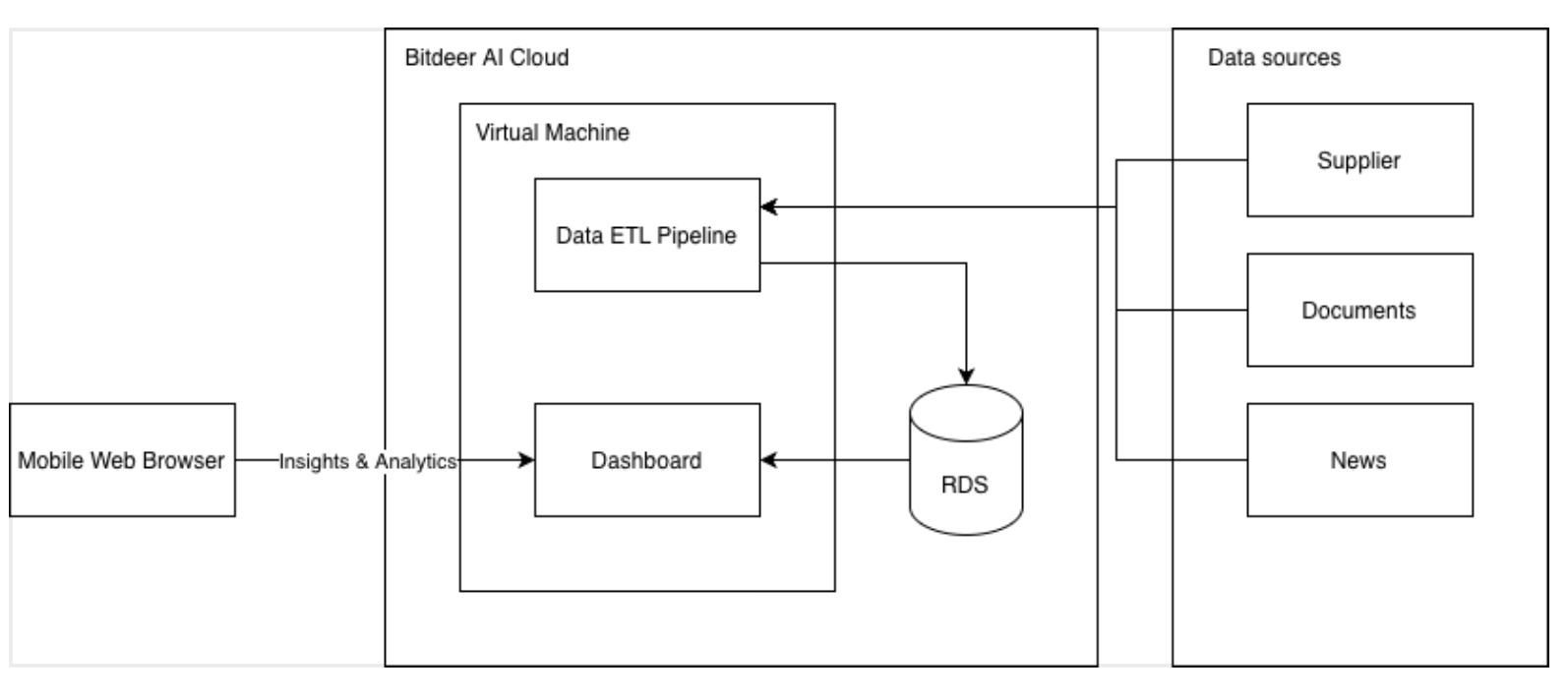
The proposed solution consolidates supplier data, documents, and external information through a centralized data pipeline. Within the system architecture, Bitdeer AI Cloud provides the virtual machine environment and data processing layer used to run ETL workflows, host the analytical dashboard, and support AI-driven insight generation.
Structured data is stored centrally, while AI models analyze supplier attributes to produce quality scores and contextual recommendations. The dashboard presents these insights in a unified view, enabling more informed and timely supplier management decisions
Outcome
The prototype illustrates how AI-supported analytics can transform supplier evaluation from manual reviews into a more systematic and insight-driven process, particularly valuable for sustainability-focused supply chains.
Use Case 2: Retail Store Intelligence for Planogram Execution
Background
Retail ground staff spend significant time executing product placement according to predefined planograms. Store managers must oversee large teams, while brand and product managers often lack direct visibility into how products are ultimately displayed on the shop floor.
Challenges
Manual reporting and visual checks are time-consuming and inconsistent. Without a structured feedback mechanism, it is difficult to assess execution quality or scale oversight across multiple stores.
Solution Architecture
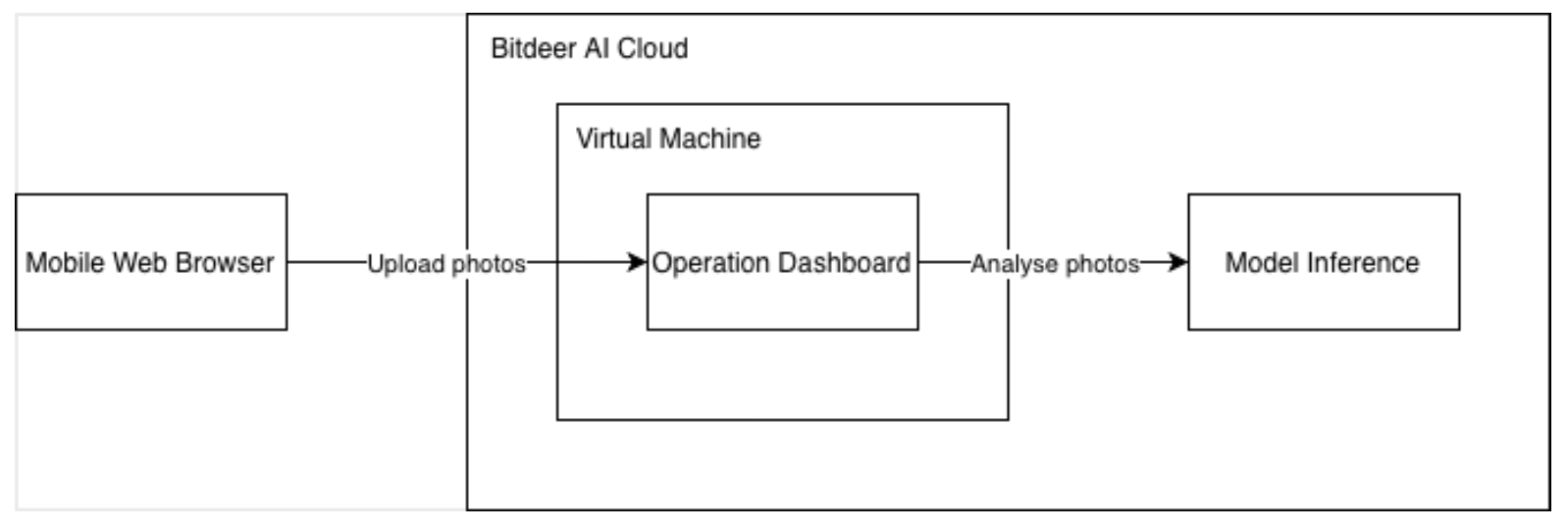
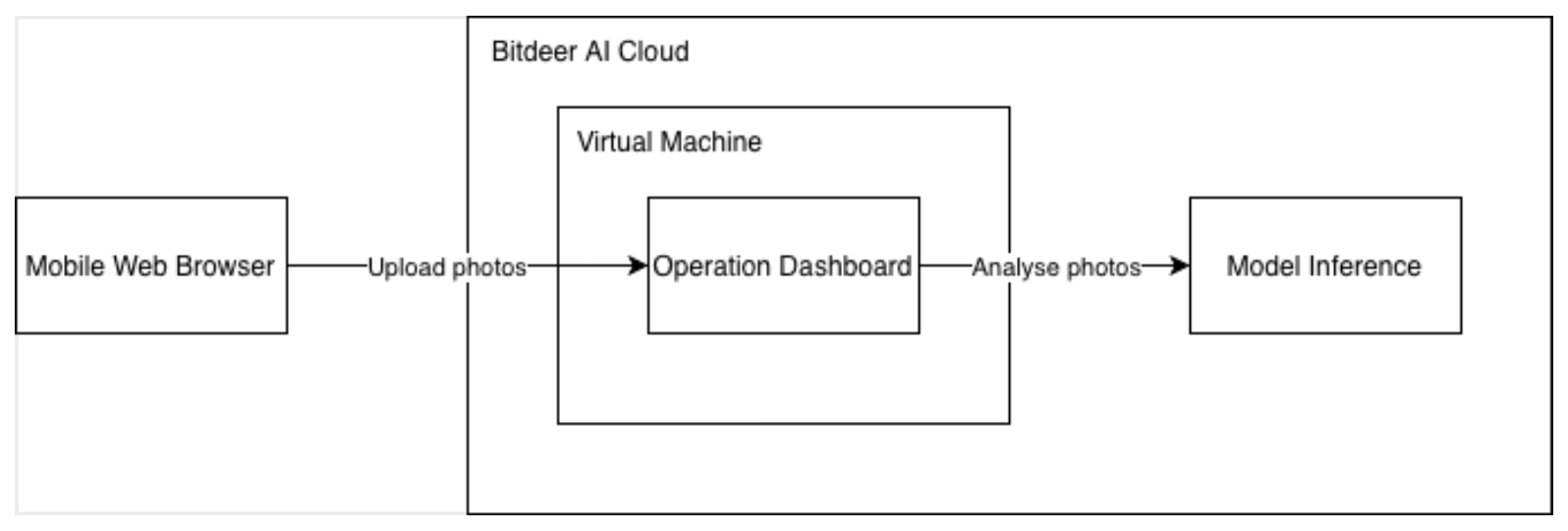
The system digitizes the planogram workflow from instruction to verification. Product placement requirements are recorded and distributed to ground staff via a centralized interface. After execution, staff upload photos through a mobile web browser.
Within the architecture, Bitdeer AI Cloud hosts the operational dashboard and supports model inference used to analyze uploaded images. The results are automatically recorded and aggregated, allowing managers to review execution status and performance without manual follow-up.
Outcome
By combining visual evidence with automated reporting, the solution improves transparency across retail operations and reduces the manual burden on both frontline staff and management.
Use Case 3: Automated Tender Document Intelligence for SMEs
Background
Singapore’s construction industry issues thousands of government tenders each year, many consisting of hundreds of pages of documentation. For SMEs, participating in these tenders is critical but resource-intensive.
Challenges
Tender documents are typically received via email and reviewed manually. Processing a single tender can take several days, placing heavy strain on small quality assurance teams and increasing the risk of missed deadlines or errors.
Solution Architecture
The proposed pipeline automates tender intake and evaluation. Incoming emails trigger document processing workflows that extract, analyze, and assess tender requirements. AI and Retrieval-Augmented Generation (RAG) techniques reference internal document repositories such as certificates and project histories to perform eligibility checks.
Bitdeer AI Cloud provides the execution environment for these automated workflows, hosting the virtual machines that run document processing, AI inference, and the dashboard used to visualize results and audit pipeline actions
Outcome
The prototype demonstrates how AI-enabled automation can significantly shorten tender review cycles, helping SMEs respond more efficiently and compete more effectively in high-volume tender environments.
Infrastructure as an Enabler, Not the Focus
Across all three use cases, Bitdeer AI Cloud functions as the underlying execution layer that supports data pipelines, AI inference, and dashboard deployment. By providing a consistent and flexible runtime environment, teams were able to focus on workflow design and problem-solving rather than infrastructure setup.
This separation between infrastructure and application logic proved critical in enabling rapid iteration within the hackathon timeframe.
Lasting Takeaways
The solutions developed through Hack to Hire demonstrate more than short term experimentation. They provide concrete examples of how AI can be operationalized when designed around real business workflows rather than isolated models or theoretical prototypes.
Across all use cases, a consistent pattern emerges. Real value is created when AI is embedded into end to end processes and supported by infrastructure that enables rapid iteration and reliable execution. In this context, Bitdeer AI is positioned as a vertically integrated AI cloud platform that unifies AI data center infrastructure with a comprehensive AI cloud layer, providing built in tools that support the full AI lifecycle from development and training to deployment and production operations. Together, these projects illustrate a pragmatic path for enterprises adopting AI by focusing on workflow integration, operational impact, and measurable outcomes.