
Key Highlights from AI Infra Summit 2026
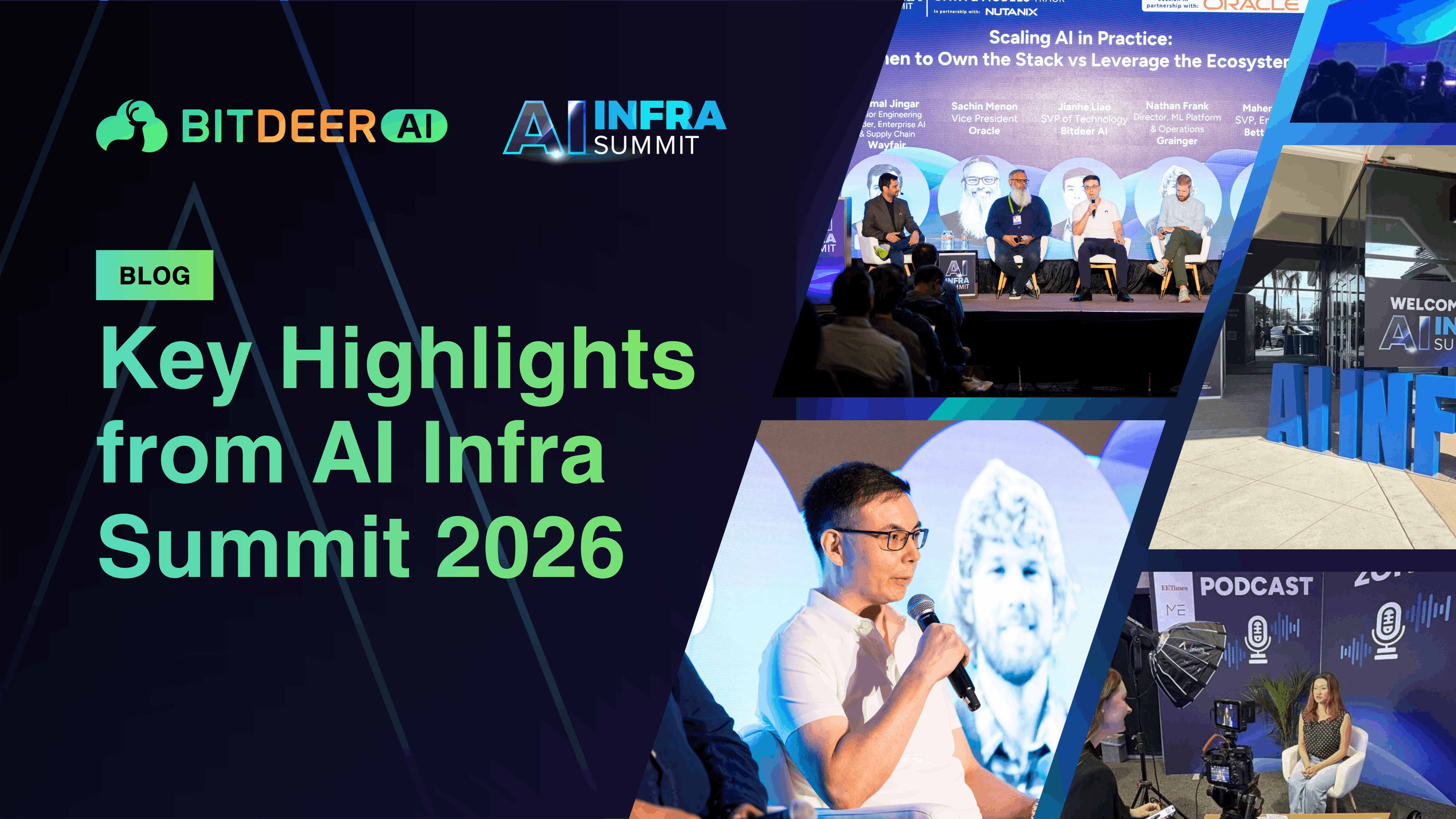
Bitdeer AI was a proud sponsor of AI Infra Summit 2026, which took place September 15-17, 2026 in Santa Clara, CA.
If we had to describe the summit in three words, it would be: Technical, Relevant, Connected. Technical, because the summit gave us an opportunity to meet a really interesting mix of AI and technology leaders from people thinking about infrastructure and compute to teams working on data, models, and AI applications. Relevant, because a lot of the conversations centered on how to move from experimenting with AI to actually scaling it reliably and efficiently. We heard repeatedly about the need for the right compute infrastructure, efficiency, scalability, and flexibility as AI workloads continue to grow. And lastly, connected because we were able to connect with leaders across the AI ecosystem and gain a better understanding of how organizations are thinking about scaling AI in the real world.
Here are some of the key themes and takeaways we heard throughout the conference:
Day 1: AI Infrastructure is Becoming a Full-Stack Systems Problem
Day 1 centered around how AI infrastructure is evolving as models become larger, workloads become more distributed and AI moves towards production and increasingly agentic use cases. In the session, Advancing Infrastructure for the Era of Agentic AI, Ian Buck, VP, Hyperscale & HPC Computing, NVIDIA, touched upon how AI infrastructure differentiation is increasingly going beyond GPU availability towards system level performance, efficiency and economics. In The AI Opportunity: Silicon to Systems, Lip-Bu Tan, CEO, Intel, emphasized that AI infrastructure extends beyond GPUs to CPUs, memory, accelerators, networking and heterogeneous systems. The Infrastructure of Intelligence: NVIDIA and OpenAI on a Decade of Building Frontier AI highlighted how frontier AI is increasingly a power and infrastructure systems challenge, requiring compute, networking, power, cooling, and reliability to be designed together. Altogether, the message from day 1 was clear: AI infrastructure is evolving from a GPU centric model towards a full-stack systems problem. Compute, networking, power, memory, software, and utilization are increasingly interconnected and overall infrastructure efficiency is becoming an increasingly important part of AI economics.
Day 2: Moving AI from Experimentation to Production
Day 2 migrated towards a discussion centered around enterprise adoption, operational complexity, distributed infrastructure and the practical economics of deploying AI at scale. In Build vs Buy Considerations for Enterprise AI Infrastructure, the discussion highlighted how build vs buy is not a binary decision. Enterprise customers increasingly need flexible infrastructure and model options that allow them to balance performance, cost, and control. Operationalizing AI: turning Data, GPUs, and Inference into Enterprise ROI session emphasized how the question is increasingly migrating from how many GPUs do we need to how do we operate AI infrastructure efficiently and generate business value from it. Day 2 surfaced the practical challenges enterprises face when moving AI into production from choosing the right models and infrastructure to managing increasingly complex distributed environments, improving utilization and balancing performance against cost and business value.
Day3: Where Should Organizations Own the Stack?
The summit concluded with Bitdeer AI’s own Jianhe Liao, SVP of Technology, speaking on the panel, Scaling AI in Practice: When to Own the Stack vs Leverage the Ecosystem. The conversation brought together many of the points discussed in the prior few days: as AI workloads and infrastructure requirements evolve, organizations are increasingly evaluating which layers they should own or customize and where they should leverage the broader ecosystem.
The panel also reinforced the build versus buy decision is not a binary one. As models, workloads, costs, and infrastructure requirements continue to change, flexibility becomes increasingly important as organizations need to be able to continuously reassess their technology decisions.
Five Key Takeaways from AI Infra Summit:
Across the 3 day summit, five key takeaways surfaced:
- AI infrastructure is becoming a full-stack systems problem.
AI Infrastructure is moving beyond GPU availability to include: compute, networking, memory, power, cooling, software and orchestration which need to work together to support production AI.
- Efficiency and economics are becoming critical.
As AI infrastructure becomes more expensive and power intensive, customers are increasingly focused on: GPU utilization, cost per token, performance per megawatt, networking efficiency, infrastructure utilization, and total cost of ownership.
- Inference and agentic AI are expanding infrastructure demand.
Inference and agentic AI are creating new demands for compute, networking, latency, memory and orchestration.
- Enterprise AI is moving towards flexible, hybrid architectures.
Enterprises are increasingly balancing control, customization, cost, performance, flexibility and speed to deployment rather than just build vs buy being a binary decision.
- Infrastructure differentiation is moving up the stack.
Infrastructure differentiation is moving beyond hardware into networking, orchestration, automation, monitoring, model serving utilization and economics.
Looking Ahead
The AI Infrastructure Summit reinforced a broader shift in the industry: that as organizations move from experimentation towards large-scale training, inference, and agentic workloads, the challenge is no longer simply access to compute. It is about how every layer of the stack works together: from physical data center and infrastructure through inference and deployment while reducing complexity, bottlenecks, and unnecessary costs along the way.
That’s what we are building at Bitdeer AI.
With a full-stack AI cloud spanning AI data centers, infrastructure, GPU cloud, and inference, we are bringing these layers together to help organizations scale AI workloads more efficiently from one layer to the next.
As the industry continues to shift AI from ambition and experimentation into production, Bitdeer AI is excited to be a part of the conversation and to continue building the infrastructure and AI solutions that help make this transition possible.