
From Models to Production: Scaling AI in a Multi-Model World
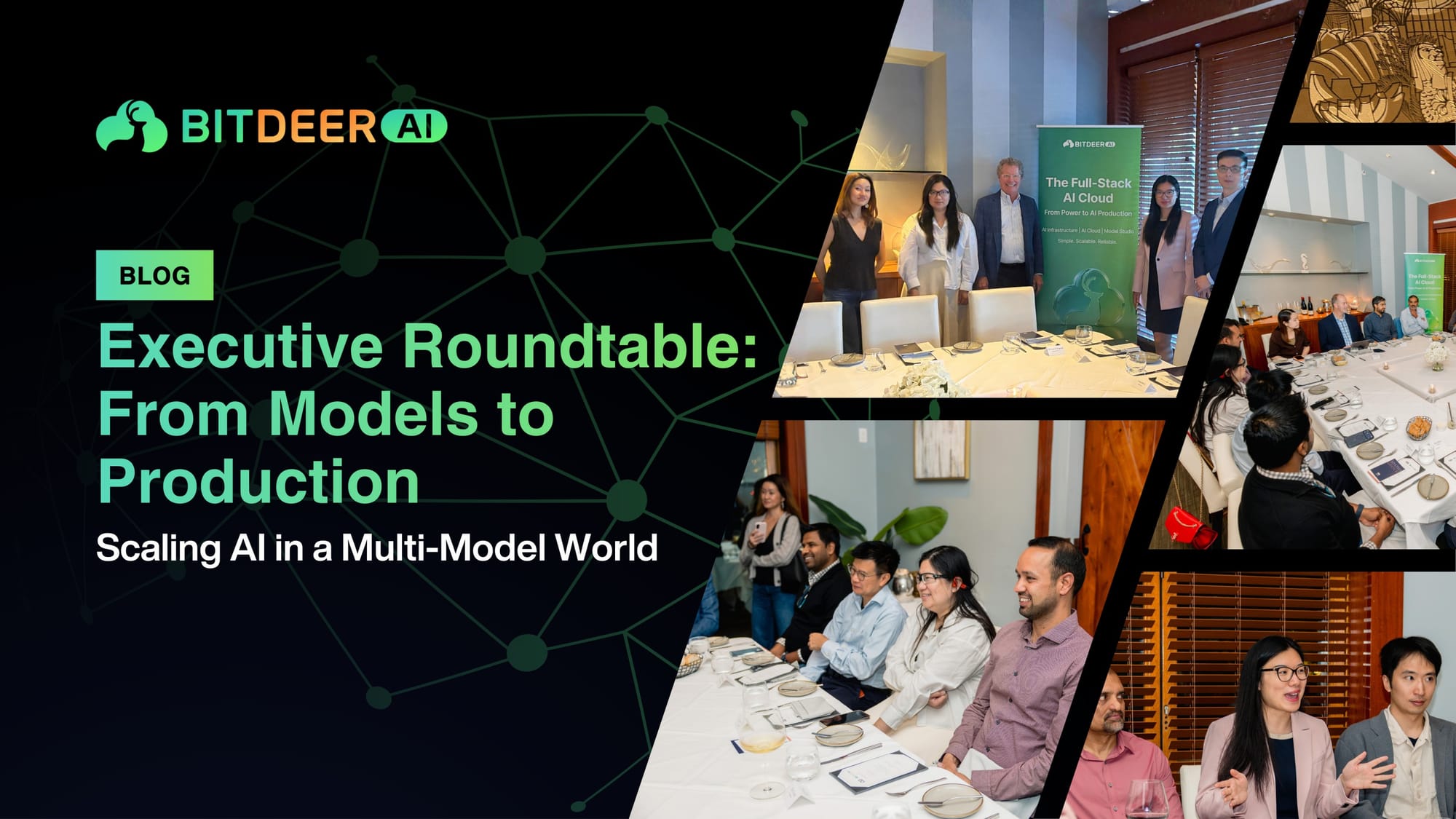
Bitdeer AI recently brought together a group of senior AI and technology leaders in Palo Alto, California, for a candid conversation on “From Models to Production: Scaling AI in a Multi-Model World.”
The discussion explored how organizations are navigating an increasingly diverse model landscape and the practical decisions that come with moving AI from experimentation into production. From model selection and inference economics to infrastructure strategy, security, and governance, one theme emerged: scaling AI is no longer just about choosing the best model. It is about determining which model and infrastructure are right for each workload and how to manage them together. Here are some key highlights from the discussion.
- The future is multi-model
Organizations are increasingly choosing models based on the workflow rather than committing to a single provider. Routing decisions depend on accuracy, task complexity, latency, data sensitivity, and cost. Platforms such as ServiceNow and Salesforce are enabling customers to switch between models, selecting the appropriate option based on task complexity, accuracy requirements, latency, data sensitivity, and cost.
This shift is driving interest in open-weight models, which can offer greater flexibility, customization, and control over deployment. However, adoption is not simply a matter of choosing a lower-cost alternative. Models have to meet internal evaluation benchmarks, satisfy governance requirements, and deliver sufficient performance to justify deployment.
Self-hosting also introduces an important economic consideration: organizations need enough sustained workload demand to justify the cost of GPU capacity and operational overhead of running models themselves. Open models can be compelling for routine enterprise tasks but not a universal replacement for frontier models.
The emerging approach is hybrid: select models according to the needs of each workflow rather than committing to a single provider or model family.
- Falling token prices doesn't mean lower AI costs
AI usage is expanding in two directions: more employees and applications are adopting AI, while agents consume more tokens through longer contexts, multiple integrations, and continuous background activity. Several participants said usage and spending are increasingly difficult to predict even as per-token prices decline because autonomous / agentic applications can generate significantly more model interactions than a simple user prompt. The economics of AI are being driven by total workload volume and complexity, not just the unit price of inference.
This is also changing how organizations evaluate AI economics. Customers increasingly care about whether AI delivers a useful result, not which models generated it or how many tokens it consumed.
The challenge is connecting those outcomes to the underlying economics: how much compute a workload requires, how efficiently it runs, and whether its value justifies the cost.
As agentic applications become more sophisticated, organizations will need better ways to understand workload behavior, manage consumption and balance performance with cost efficiency. The challenge is no longer limited to reducing cost per token but managing the economics of AI at scale.
- The right compute strategy depends on where an organization is in its AI journey
The discussion drove home the common progression in AI infrastructure strategy: organizations may begin with proprietary model APIs, explore open models as their requirements evolve, and consider rented or owned GPU capacity as workloads become more demanding.
This is not a universal path but it does highlight how infrastructure decisions change as AI adoption matures. Early stage companies may favor APIs to avoid large upfront investments, while organizations with sustained, predictable workloads may find dedicated or owned capacity worth evaluating. Early stage companies often lack the capital for large upfront commitments but at the same time, compute requirements can grow rapidly, making long-range capacity planning difficult. The conversation highlighted the right infrastructure model depends on workload maturity, sustained utilization, capital availability, and the ability to secure reliable capacity. Flexibility matters because an infrastructure strategy that works during experimentation may not be the right fit for production at scale.
- Security, governance and quality remain critical to production AI
For enterprises in regulated industries, particularly financial services, the decision to deploy AI extends beyond cost and model performance. Data sensitivity, regulatory obligations, internal approval processes and consequences of model errors all influence which models and deployment approaches are acceptable. One example shared during the roundtable, illustrated how a model approval process had been shortened from approximately six months to two weeks but new production use cases still require rigorous governance and oversight. Participants also disagreed on whether open models are suitable for coding workloads, where quality expectations can be very high. The debate reinforced the broader point that a model that performs well for one task may not be appropriate for another.
As AI moves into production, organizations must balance flexibility and cost efficiency with performance, reliability, and security.
Next Phase of AI will depend on matching workloads to the right models and infrastructure
The group agreed that looking ahead, there is a shift towards intelligent workload routing across multiple models and infrastructure options. Rather than relying on a single model or deployment approach, organizations are likely to combine frontier and open models according to their respective strengths while making infrastructure decisions based on workload requirements and economics.
No single model or infrastructure strategy emerged as the answer for every organization. Frontier models can provide strong capabilities but may come with higher costs meanwhile open models can offer cost / flexibility advantages, although capabilities may vary depending on the task. The central question is shifting from Which model is best? to Which model and infrastructure approaches are right for this workload?
On a broader scale, three key themes emerged from the roundtable:
- Enterprises need flexible infrastructure to support multiple models, evolving workloads and production-scale inference.
- Rising AI usage, unpredictable compute demand, and the economics of open models are making capacity planning and cost efficiency increasingly important.
- Production AI requires coordination across models, data, infrastructure, and governance to deliver reliable business outcomes.
Connecting the layers of production AI
All of these challenges are closely interwoven. Model selection affects inference economics and performance. Workload patterns influence compute requirements and security, data control, and governance shape how and where models can be deployed. As AI applications become more complex, organizations need to evaluate these considerations together rather than treating them as separate decisions.
This is where the underlying infrastructure becomes increasingly important to bring AI workloads into production and support them as demand grows.
Bitdeer AI’s AI Cloud offering is focused on the compute and infrastructure layer that enables organizations to develop, deploy and scale AI workloads. With a full-stack AI cloud spanning AI data centers, infrastructure, GPU cloud, and inference, Bitdeer AI aims to support customers as their applications capacity requirements, and deployment needs evolve.
As organizations move beyond experimentation, the ability to access flexible GPU compute and scale capacity with changing demand becomes an important part of the production AI equation. The ability to align compute capacity with workload requirements can help organizations navigate changing demands while evaluating performance, utilization, and cost.
Ultimately, scaling AI in production isn’t just about choosing a better model, instead it’s about having the infrastructure and flexibility to run the right workloads at the right scale as AI evolves.