
GLM-5.3 now live on Bitdeer AI Model Studio, built to Code and Ready for Cyber Defense
People say most gains in frontier AI come from bigger base models. Z.ai just showed that isn't the only path: GLM-5.3 uses the exact same foundation model as its predecessor, GLM-5.2, and still delivers the largest coding and security jumps in the GLM family's history, entirely through scaled post-training. For engineering and security teams running long-horizon coding agents or vulnerability-discovery pipelines, that means a meaningfully more capable model without waiting on a new base model cycle.
Today, Z.ai GLM-5.3, described as "Built to Code. Ready for Cyber Defense," is available on Bitdeer AI Model Studio, bringing one of the strongest open-weight coding and agentic models to our serverless inference platform, built for secure, scalable enterprise AI. You can start calling it through a single API today, without provisioning or managing the underlying GPU infrastructure.
What Is GLM-5.3?
GLM-5.3 is Z.ai's newest release in the GLM-5 family, a Mixture-of-Experts (MoE) foundation model with 744B total parameters and roughly 40B activated per forward pass, using a sparse attention mechanism for efficient long-context inference. Critically, GLM-5.3 reuses the same base weights as GLM-5.2 unchanged. Every reported capability gain comes from an extended post-training pipeline, built on a larger set of task environments, more environment types, and Z.ai's asynchronous agentic reinforcement learning framework.
That approach concentrated gains in two areas: long-horizon coding and cybersecurity. Z.ai reports GLM-5.3 is its most powerful open-weights coding model to date, with the largest jumps on the hardest, most agentic benchmarks, and says the model's vulnerability-discovery ability advanced further than the team expected, with GLM-5.3 beginning to reason across multiple stages of an exploit and form coherent plans for complete exploitation chains.
Key Specifications
Why Post-Training-Only Gains Matter
Enterprises evaluating always-on coding and security agents run into a familiar set of tradeoffs:
New base model vs. faster iteration. Retraining a foundation model is slow and expensive. Z.ai's result shows a mature base can still absorb large capability gains through post-training alone, which means meaningful upgrades can ship faster and more often.
General coding ability vs. long-horizon execution. Many models handle short coding tasks well but degrade over long, multi-step agent runs. GLM-5.3's gains concentrate exactly there, on benchmarks that measure sustained, multi-step execution rather than single-shot code generation.
Open access vs. dual-use risk. GLM-5.3's cybersecurity ability is strong enough that Z.ai delayed the open-weight release to complete what it calls its most extensive risk review to date. That is a meaningful signal for enterprises about the model's real-world capability, and about the seriousness with which Z.ai is treating deployment.
Coding and Agentic Performance
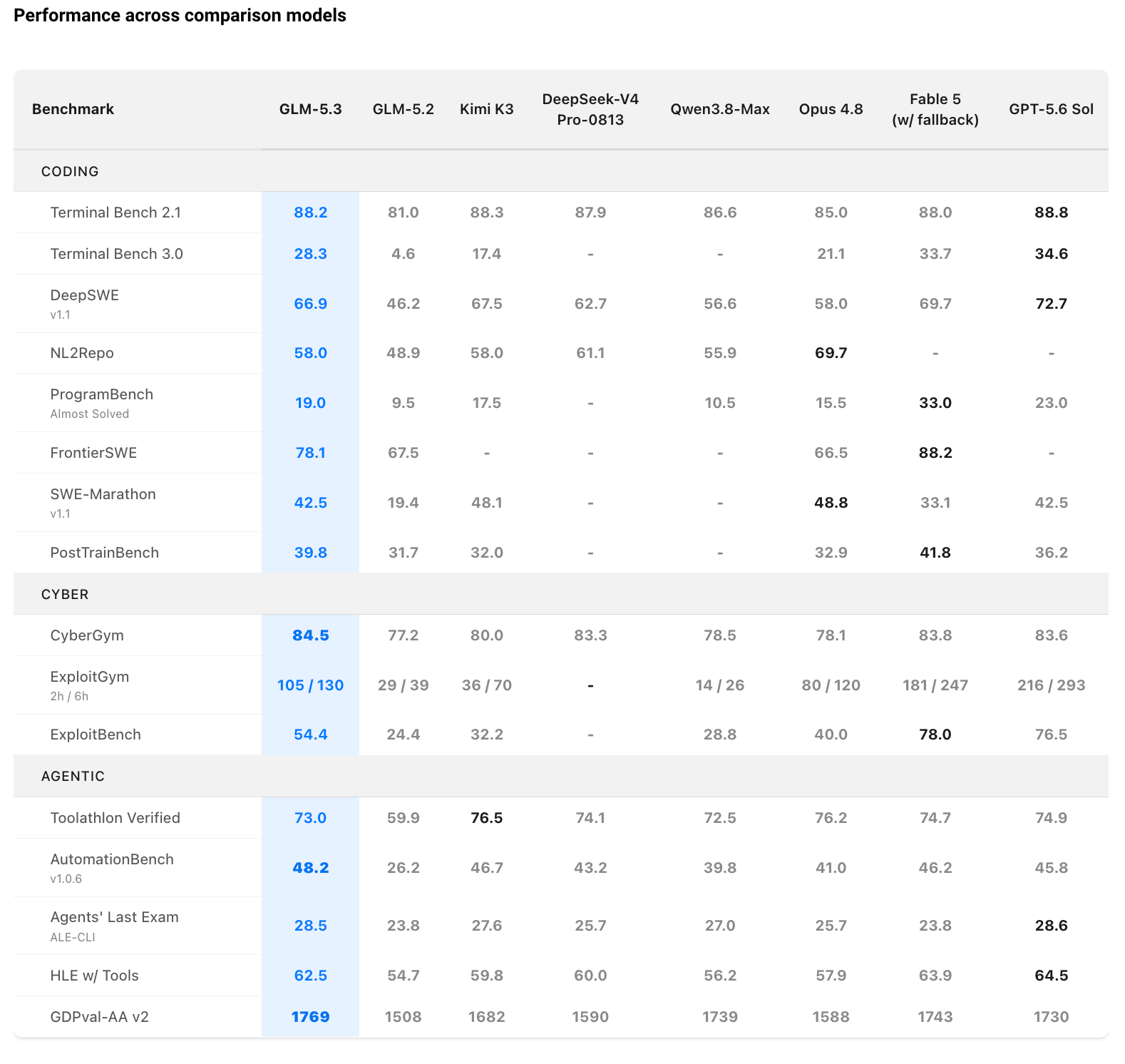
Z.ai reports a 50% improvement over GLM-5.2 on its internal Z.ai Code Bench, and open-source state-of-the-art results on several public agentic benchmarks:
Source: Z.ai
The largest jumps land on the longest-horizon, most agentic tasks, such as Terminal-Bench 3.0, which measures a model's ability to chain shell commands, read output, and recover from errors across many steps. On public leaderboards, GLM-5.3 trails top closed frontier models on some of the hardest coding evaluations, and Z.ai is transparent that its headline 50% figure comes from an internal benchmark designed to reduce contamination risk rather than an independently reproducible public suite.
An Unplanned Cybersecurity Result
Z.ai says it added vulnerability-discovery training data expecting incremental gains in single-bug reasoning. Instead, capability kept compounding as training scaled, and the model began forming coherent, multi-stage exploitation plans rather than single-step findings.
Working with security teams and research groups, Z.ai used GLM-5.3 to find 2,436 vulnerabilities across 269 open-source projects, some in codebases around 40 years old. On benchmarks:
The CyberGym score edges past both Claude Mythos 5 (83.8%) and GPT-5.6 Sol (83.6%), though the margin is close enough that run-to-run variance could account for it. ExploitBench, which requires root-cause reasoning through to a working exploit, more than doubled but still trails Mythos 5's 78.0%, underscoring that the deepest, most ambiguous exploitation reasoning remains a frontier-model strength for now.
Use Cases
Long-horizon coding agents. Repository-scale refactors, CI failure triage, and multi-step backend engineering that require sustained context and error recovery across dozens of tool calls.
Application and product security. Secure code review, crash triage, and white-box vulnerability discovery for teams shipping kernels, browser engines, network stacks, or other security-sensitive software.
DevSecOps pipelines. Automated pull-request review and CI-integrated static and dynamic analysis that flags exploitable patterns before code ships.
Fintech and e-commerce engineering. Long-running agents that maintain complex, multi-service codebases where reliability and instruction-following over many steps matter as much as raw code quality.
MSSPs and security vendors. Structured vulnerability triage, correlation, and reporting at a scale that would otherwise require significant analyst headcount.
Run GLM-5.3 via API on Bitdeer AI Model Studio
You can run GLM-5.3 on Bitdeer AI Model Studio, our serverless inference platform designed to make access to advanced foundation models simple and scalable. With a unified API, our Model Studio lets developers and enterprises start using models quickly without managing underlying infrastructure, reducing deployment complexity and time to value, so you can plug a frontier-adjacent coding and security model into your agent stack without standing up new serving infrastructure.
Bitdeer AI is a preferred NVIDIA Cloud Partner, certified to ISO/IEC 27001:2022 and SOC 2 Type I & Type II, providing the secure, compliant, high-performance, enterprise-grade infrastructure that production agentic AI deployments require.
Get Started
- Log in to Bitdeer AI Model Studio.
- Locate GLM-5.3 in the model list.
- Generate an API key and start making API calls.
curl -v --location 'https://api-inference.bitdeer.ai/v1/chat/completions' --data '{"model":"zai-org/GLM-5.3","messages":[{"role":"system","content":"You are a knowledgeable assistant. Provide concise and clear explanations to scientific questions."},{"role":"user","content":"Can you explain the theory of evolution in simple terms?"}],"max_tokens":200,"top_p":1.0,"temperature":1.0,"frequency_penalty":0.0,"presence_penalty":0.0,"seed":42,"stream":false}' --header 'Authorization: Bearer <API_KEY>'
Conclusion
GLM-5.3 is a reminder that frontier progress doesn't always require a new base model, it can come from teaching an existing one to reason further and plan longer.