
Mystery Solved: Ox Alpha is GLM-5.3-Flash, and It's Now Live on Bitdeer AI Model Studio
On August 20, 2026, a mysterious model appeared on OpenRouter.
The model listing contained only a single identifier: stealth/ox-alpha. Its only publicly available information was a 1-million-token context window, native support for text, image, and video input, and unlimited free access during the preview period.
The result was the largest model launch in OpenRouter's history. Within just a few days, Ox Alpha surged to the top of the platform’s usage leaderboard. Engineers discovered that this mysterious model could complete tasks that were expected to require a frontier model.
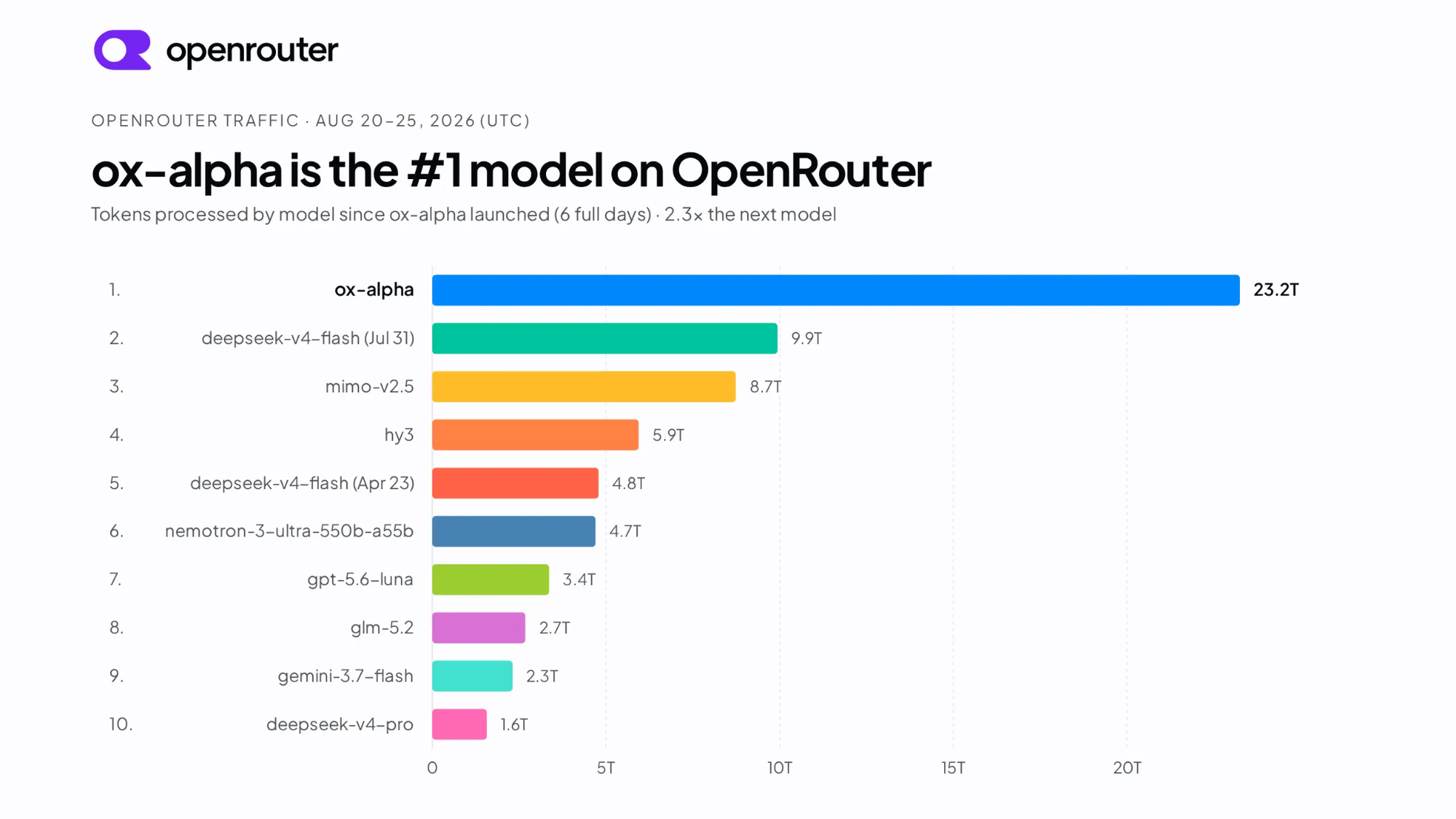
Source: OpenRouter
Subsequently, the community began "fingerprinting," and speculation continued for an entire week, ultimately locking onto a "suspect."
On August 26, the mystery was solved. Z.ai announced that Ox Alpha is a brand-new iteration of the GLM series: GLM-5.3-Flash, a Mixture-of-Experts (MoE) model with 320B total parameters and 18B active parameters, and the first natively multimodal member of the GLM-5 series.
Today, GLM-5.3-Flash is officially live on Bitdeer AI Model Studio, our serverless inference platform built for enterprise-grade security and elastic scaling. You can start calling it immediately, without managing underlying infrastructure and without the need to route through anonymous providers.
What is GLM-5.3-Flash?
GLM-5.3-Flash is a Mixture-of-Experts (MoE) model with 320B total parameters and 18B active parameters per token. Z.ai describes it as the first natively multimodal model in the GLM-5 series, built from a newly trained base model rather than post-trained down from the GLM-5.3 flagship, with its architecture and training recipe redesigned around capability-per-unit-of-compute.
Per Z.ai's published results, it outperforms GLM-5.2 across benchmarks and real-world workloads at roughly one-tenth the price, while approaching Claude Opus 4.8 on coding and agentic benchmarks. The weights are published on Hugging Face under an MIT license.
Three architectural changes are worth understanding, because they are the reason the stealth preview held up under real production load:
- Hybrid sparse and linear attention. For the first time in the GLM series, Z.ai combines linear attention, which handles local dependencies efficiently, with sparse attention, which retrieves the globally relevant context. This sharply reduces long-context serving cost while preserving precise long-context behavior.
- IndexPool. At million-token context lengths, retrieval itself becomes the bottleneck. IndexPool compresses groups of indexer key vectors through weighted pooling to hold down latency and memory. Z.ai reports approximately 3× less attention compute and a 4.4× smaller KV cache compared with GLM-5.3.
- Manifold-Constrained Hyper-Connections (mHC). Adopted to improve scaling efficiency, letting the model deliver more capability per unit of activated compute.
Together with a 30T-token multimodal pre-training corpus, these changes are what let a model with only 18B active parameters land within striking distance of frontier coding scores.
Key Specifications
Reported Performance
According to Z.ai, across six coding and agentic benchmarks, GLM-5.3-Flash consistently outperforms GLM-5.2, often by a wide margin: 63.4 vs. 46.2 on DeepSWE v1.1 and 48.8 vs. 26.2 on AutomationBench, while approaching Claude Opus 4.8 overall.
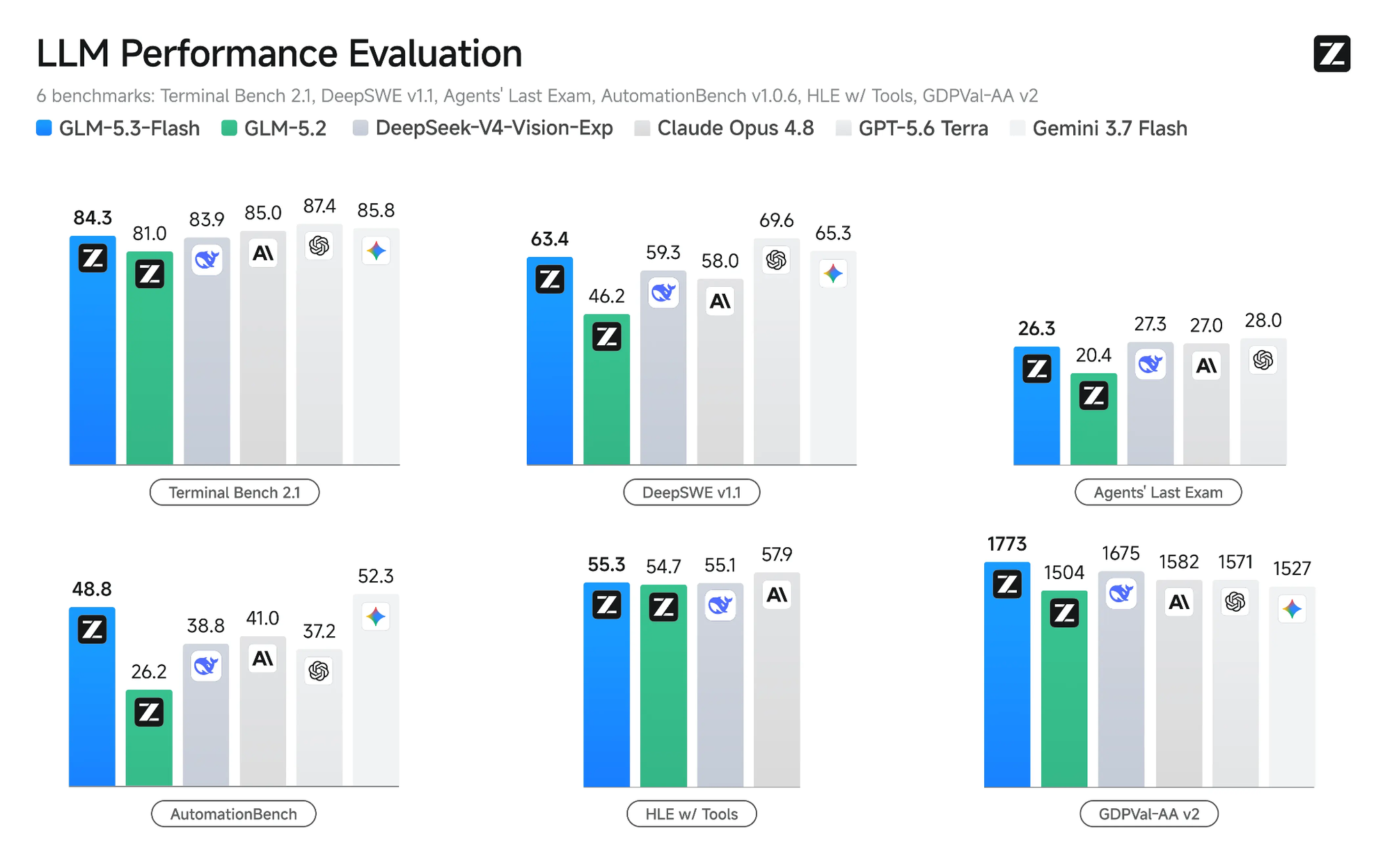
Source: https://z.ai/blog/glm-5.3-flash
Artificial Analysis scores GLM-5.3-Flash at 57 on its Intelligence Index v4.1.1, placing it among the strongest intelligence-per-dollar options currently available in open weights.
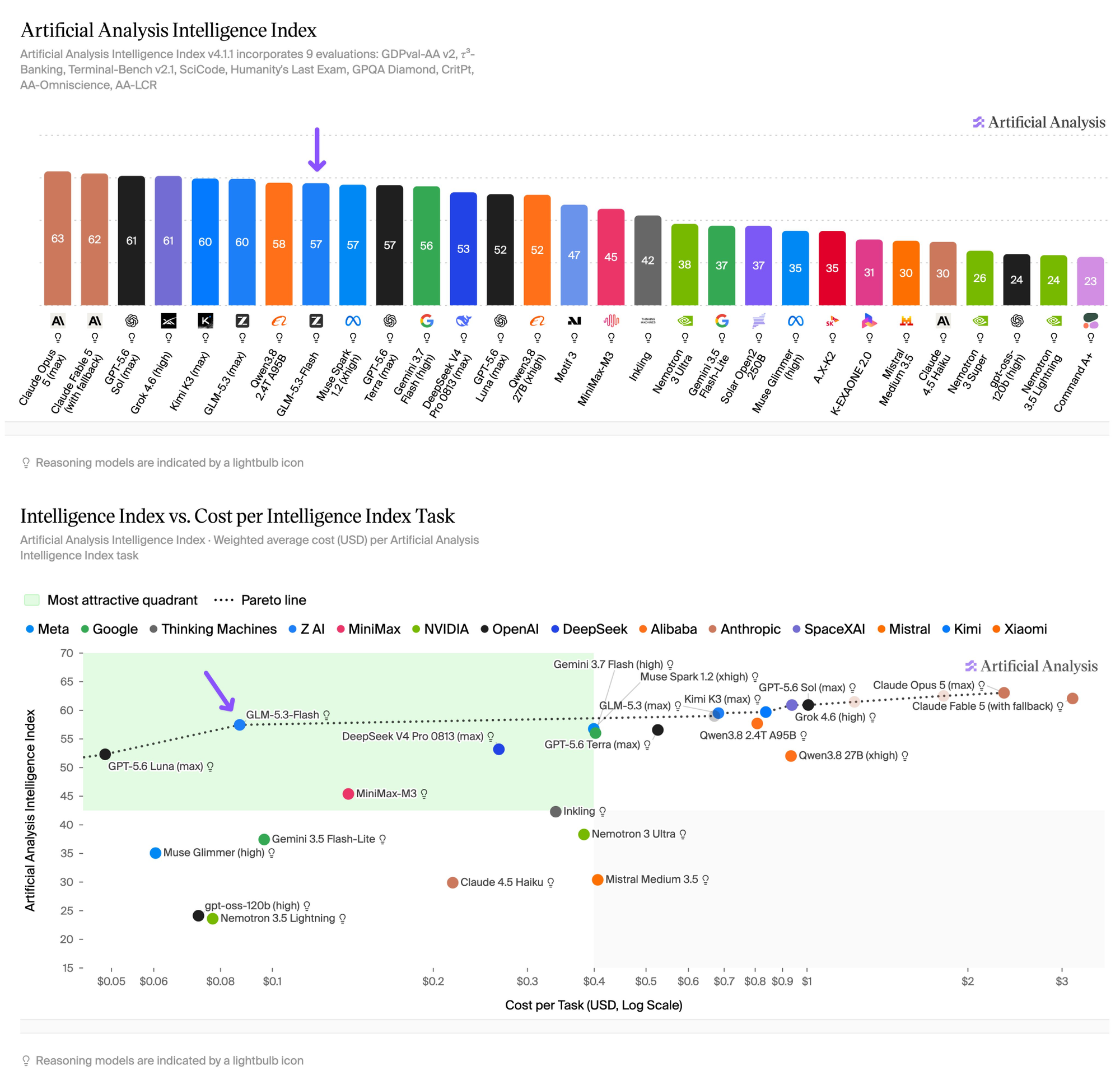
Source: Artificial Analysis
Why This Matters for Agent Economics
As enterprises move agentic systems into production, a familiar set of tradeoffs comes into focus. GLM-5.3-Flash addresses them from a specific direction:
Context cost vs. context length. Most models with large advertised windows become uneconomical well before you reach the limit, because attention cost scales against you. The hybrid attention design attacks this directly: roughly 3× less attention compute and a 4.4× smaller KV cache mean a million-token window that is usable in production, not just on a spec sheet.
Multimodal vs. pipeline complexity. Teams building agents that read dashboards, verify UI regressions, or process scanned documents typically stitch together an OCR or vision-to-text stage before the reasoning model. Native image and video input removes that stage, along with the accuracy loss and latency it introduces.
Capability vs. cost. Routing every agent step to a frontier model is expensive when most steps are high-volume and repetitive. A model that approaches frontier coding scores at a fraction of the per-token cost changes which steps you can afford to run at all, and how many iterations an agent can take before finishing.
Openness vs. production readiness. MIT-licensed weights mean the model can be owned, audited, and self-hosted. But a 320B model is a serious deployment project even at 18B active: FP8 weights alone run to roughly 306 GiB before KV cache, on top of tensor parallelism, memory capacity, and serving-stack decisions.
Enterprise Use Cases
Repo-scale coding and engineering agents. Hold an entire codebase in context rather than chunking it, and run long-horizon terminal and refactoring tasks where the agent needs continuity across many turns.
Browser and computer-use agents. Native visual input lets agents interpret what is actually on screen, navigate interfaces, and verify outcomes without a separate vision stage.
Million-token document and log analysis. Contract review, compliance checks, incident forensics, and post-mortem analysis over corpora that would otherwise require a retrieval pipeline and its failure modes.
Visual QA and UI regression checking. Compare screenshots against expected states, describe visual defects, and file structured findings.
Back-office and knowledge work automation. Spreadsheet, deck, and dashboard reasoning where the source material is visual and the task requires structured output.
Run GLM-5.3-Flash via API on Bitdeer AI Model Studio
You can run GLM-5.3-Flash on Bitdeer AI Model Studio, our serverless inference platform designed to make access to advanced foundation models simple and scalable. With a unified, OpenAI-compatible API, Model Studio lets developers and enterprises start using models quickly without managing underlying infrastructure, reducing deployment complexity and time to value.
One of the practical advantages of an MIT-licensed open-weight model is portability: the weights are not tied to any single serving environment. Bitdeer AI serves MaaS on the NVIDIA compute infrastructure that we own and operate, in our own data centers. As a preferred NVIDIA Cloud Partner, certified to ISO/IEC 27001:2022 and SOC 2 Type I & Type II, we provide the secure, compliant, high-performance foundation that production agentic deployments require.
Get Started
- Log in to Bitdeer AI Model Studio.
- Locate zai-org/GLM-5.3-Flash in the model list.
- Generate an API key and start making API calls.
curl -v --location 'https://api-inference.bitdeer.ai/v1/chat/completions' --data '{"model":"zai-org/GLM-5.3-Flash","messages":[{"role":"system","content":"You are a knowledgeable assistant. Provide concise and clear explanations to scientific questions."},{"role":"user","content":"Can you explain the theory of evolution in simple terms?"}],"max_tokens":512,"top_p":1.0,"temperature":1.0,"frequency_penalty":0.0,"presence_penalty":0.0,"seed":42,"stream":false}' --header 'Authorization: Bearer <API_KEY>'
Conclusion
Agentic workloads are no longer bottlenecked on intelligence. They are bottlenecked on how much context a team can afford to carry, and on how many pipeline stages sit between the agent and what it needs to see. GLM-5.3-Flash addresses both: 320B total parameters with 18B active, a hybrid attention architecture that makes a 1M-token window economically usable, native image and video input, and MIT-licensed weights you can own.
With GLM-5.3-Flash now available on Bitdeer AI Model Studio, you can start building against it today on secure, enterprise-grade infrastructure, and scale onto dedicated Bitdeer AI GPU capacity when your production volumes call for it.