
Key AI Infrastructure Takeaways from Ai4 2026
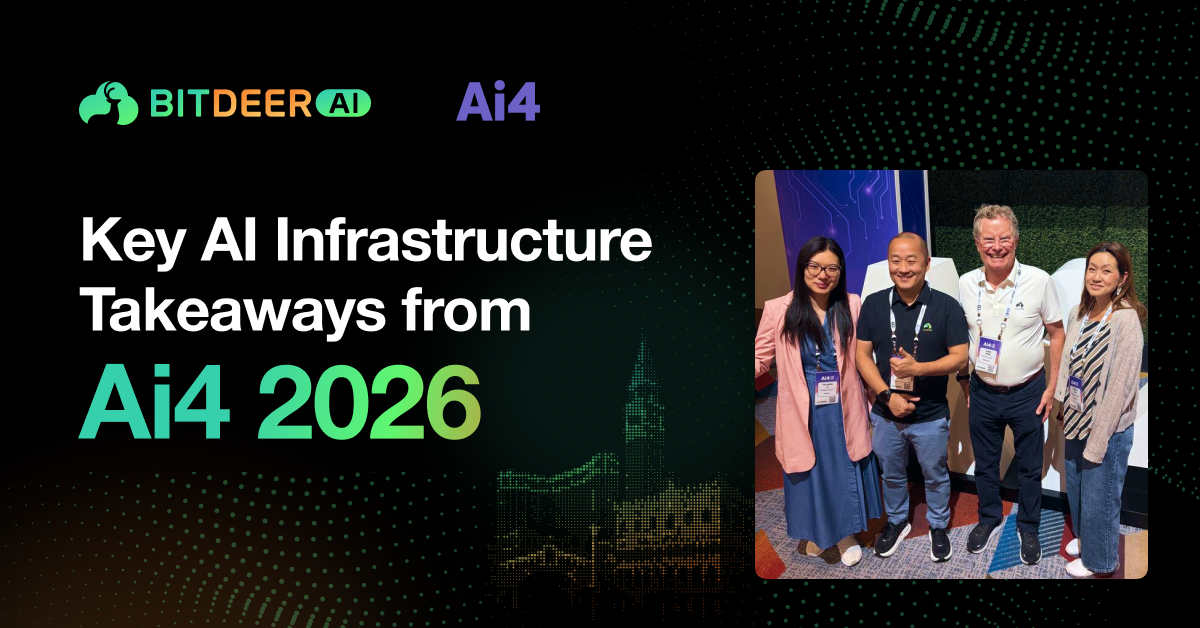
The Bitdeer AI team had a productive experience at Ai4 2026 in Las Vegas, NV, August 4-6, 2026, connecting with customers, partners, and industry leaders while attending sessions across AI infrastructure, enterprise adoption, AI applications, and emerging technologies.
An overarching theme of the event was AI innovation is moving beyond just experimentation and model development and towards production scale deployment thus creating an increasing demand for reliable, scalable, and accessible AI infrastructure.
The conference itself showed a clear progression across three days with the first day focusing on infrastructure constraints limiting AI growth, to the challenges of operationalizing AI and ending with what it takes to deploy AI reliably and responsibly in production.
Day 1 Highlights
Day 1 focused on infrastructure requirements behind the rapid expansion of AI. In one of the opening keynotes, The AI Reckoning: Chips, Constraints and the Next-Generation of Compute, Pat Gelsinger, Playground Global, emphasized AI innovation is accelerating rapidly but hardware limitations and infrastructure including GPU availability, energy capacity, data center scalability, networking, and hardware innovation are critical limiting factors. The same theme emerged in discussions around AI-driven healthcare and drug discovery. In From Molecule to Market: How AI is Reshaping Drug Discovery session, speakers highlighted how AI is being applied across target identification, molecule design, clinical research and trial optimization helping to accelerate discovery cycles and improve decision making. But on the flip side, the discussion honed in on how access to sufficient compute is becoming a constraint to this AI-driven research. As AI expands into compute-intensive industries including healthcare, scientific research, robotics, and advanced simulation, infrastructure capacity will be influential in how quickly organizations can turn AI innovation into real world outcomes.
Day 2 Highlights
Day 2 delved into the challenges of organizations figuring out how to operationalize AI. The day kicked off with a keynote, The Architects of Intelligence: A Historic Convergence with speakers that included Geoffrey Hinton, Fei-Fei Li, Andrew Ng, where they explored the broader implications of AI adoption. The conversation surfaced the importance of balancing optimism around AI’s potential with responsible adoption while investing in education and AI literacy to help organizations and communities adapt.
Following keynotes from Vultr and PayPal highlighted the challenge is no longer AI capability, it is enterprise adoption and operationalization. While frontier AI companies continue pushing model capabilities, enterprises are increasingly focused on how to operationalize AI through scalable infrastructure, inference, AI agents, and secure deployment environments. As model capabilities continue to advance, organizations increasingly need infrastructure, platforms, and operational capabilities required to turn these capabilities into business outcomes.
Day 3 Highlights
The conference ended with conversations centered on how to make AI reliable enough for production. Successful AI adoption requires a combination of infrastructure, security, governance, and workforce readiness. Across keynotes and sessions from Cisco, Waymo, and Crusoe, the message was clear: building an AI model or prototype is only the beginning. The real challenge is deploying AI reliably at scale. Organizations are more and more focused on: production-ready AI applications and agents, reliable inference and workload performance, operational consistency, continuous evaluation and measurement, scalability and predictable performance and moving from demos to mission-critical workloads.
Final Takeaway
Altogether, the conference delivered a clear message: AI is no longer just building more capable models. AI is moving from experimentation to production and the infrastructure supporting it must evolve accordingly, transitioning from providing compute to delivering reliable, scalable, secure, and production-ready AI environments.
For Bitdeer AI, these trends reinforce the importance of providing organizations with flexible infrastructure and cloud capabilities across the AI stack. Bitdeer AI combines AI Datacenter, AI Infrastructure, AI Cloud, and Model Studio / MaaS capabilities to support an organization's full journey from experimentation to production. As enterprises scale AI, access to reliable infrastructure and flexible model-access capabilities allows organizations to accelerate deployment and improve scalability, performance, and operational flexibility without having to build every layer themselves.